meta.h File Reference
#include <type_traits>
Include dependency graph for meta.h:
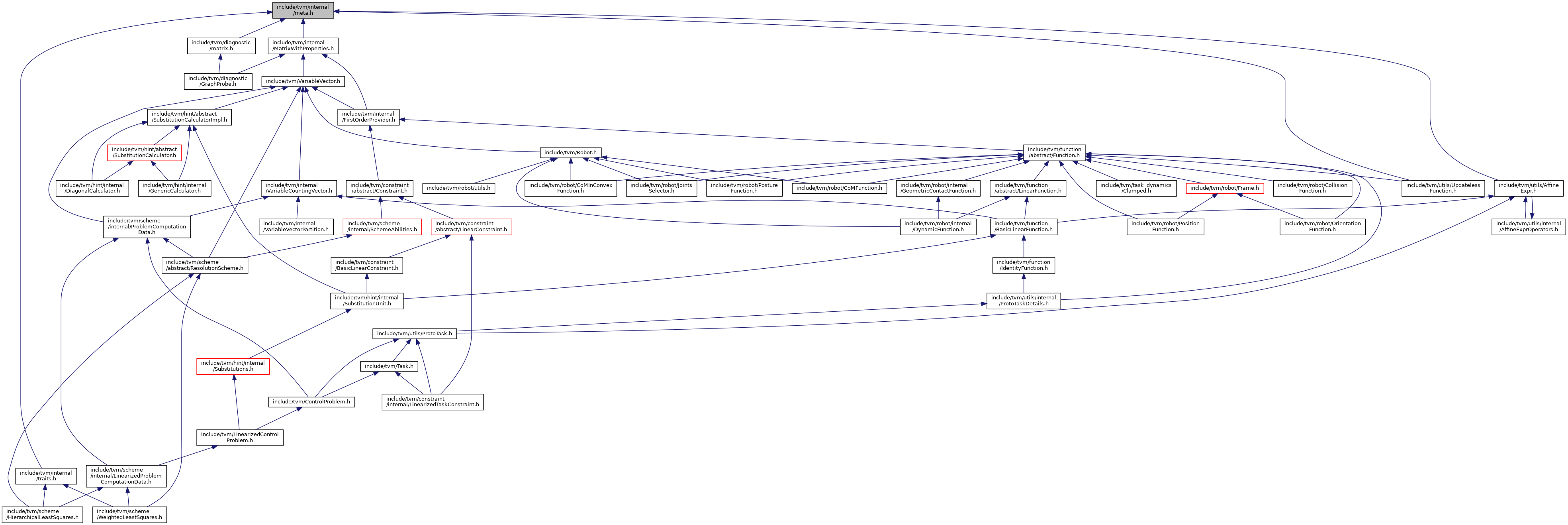
This graph shows which files directly or indirectly include this file:
Go to the source code of this file.
Classes | |
| struct | tvm::internal::is_base< Base > |
| class | tvm::internal::always_true< T > |
| class | tvm::internal::always_false< T > |
Namespaces | |
| tvm | |
| tvm::internal | |
Macros | |
| #define | TVM_CREATE_HAS_MEMBER_TYPE_TRAIT_FOR(Type) |
Typedefs | |
| template<typename T , typename... Base> | |
| using | tvm::internal::enable_for_t = std::enable_if_t<(...||(std::is_same_v< T, Base >||derives_from< T, Base >())), int > |
| template<typename T , template< typename... > class... Base> | |
| using | tvm::internal::enable_for_templated_t = std::enable_if_t<(...||derives_from< T, Base >()), int > |
| template<typename T , template< typename... > class... Base> | |
| using | tvm::internal::disable_for_templated_t = std::enable_if_t<!(...||derives_from< T, Base >()), int > |
| template<typename T , bool c> | |
| using | tvm::internal::const_if = std::conditional< c, const T, T > |
| template<typename T , bool c> | |
| using | tvm::internal::const_if_t = typename const_if< T, c >::type |
Functions | |
| template<typename T , template< typename... > class Base> | |
| constexpr bool | tvm::internal::derives_from () |
Macro Definition Documentation
◆ TVM_CREATE_HAS_MEMBER_TYPE_TRAIT_FOR
| #define TVM_CREATE_HAS_MEMBER_TYPE_TRAIT_FOR | ( | Type | ) |
Value:
namespace tvm::internal \
{ \
struct has_type_##Type##_helper \
{ \
template<typename T> \
std::false_type has(...); \
\
template<typename T> \
std::true_type has(typename T::Type *); \
}; \
\
template<typename T> \
}
Definition: CallbackManager.h:12
Copyright 2017-2020 CNRS-AIST JRL and CNRS-UM LIRMM For a name XXX, this creates a templated struct has_public_member_type_XXX in the namespace tvm::internal such that has_public_member_type_XXX<T>::value is true if T::XXX is a public, valid expression and refers to a type, and false otherwise.
